What Are Fire Extinguisher Services?
Fire extinguishers are the first line of defense against small fires. They are required in virtually every commercial, industrial, and multi-family residential building in California. But a fire extinguisher is only useful if it is properly maintained, correctly placed, fully charged, and appropriate for the hazards present in the space. Fire extinguisher services encompass the full lifecycle of these essential devices: selection, placement, annual inspection, six-year maintenance, hydrostatic testing, recharging, and eventual replacement.
Delta Fire Equipment provides comprehensive fire extinguisher services across all of California. Our licensed technicians service thousands of extinguishers every year for commercial buildings, industrial facilities, restaurants, hotels, schools, hospitals, and residential properties. We handle everything from a single extinguisher replacement to facility-wide inspection programs covering hundreds of units across multiple locations.
Why Regular Extinguisher Service Matters
An extinguisher that has lost pressure, has a corroded valve, or contains an expired agent will not perform when someone reaches for it during a fire. California Title 19 and NFPA 10 (the Standard for Portable Fire Extinguishers) require annual inspections to verify that every extinguisher is accessible, visible, fully charged, undamaged, and ready to operate. Failing to maintain extinguishers is not just a safety risk; it is a code violation that can result in fines, failed fire inspections, and insurance complications.
Beyond annual inspections, NFPA 10 requires a more thorough six-year maintenance examination for stored-pressure extinguishers and a twelve-year hydrostatic pressure test for the cylinder itself. These intervals are not optional. They are mandatory service milestones that ensure the mechanical integrity of the extinguisher throughout its service life.
Types of Extinguishers We Service and Sell
Delta Fire Equipment services and supplies every major type of portable fire extinguisher used in California:
- ABC Dry Chemical — The most versatile and widely used type, effective on Class A (ordinary combustibles), Class B (flammable liquids), and Class C (electrical) fires. Required in most commercial and industrial spaces.
- CO2 (Carbon Dioxide) — Clean-agent extinguishers that leave no residue, making them ideal for server rooms, data centers, laboratories, and areas with sensitive electronic equipment. Effective on Class B and Class C fires.
- Class K (Wet Chemical) — Specifically designed for commercial kitchen fires involving cooking oils and fats. Required in all commercial kitchens in California alongside the hood suppression system. The wet chemical agent cools and saponifies burning grease to prevent reignition.
- Water and Foam — Used in environments where Class A fire hazards predominate and where clean-agent considerations are important. Common in hotels, hospitals, and office environments.
- Halotron and Clean Agent — Environmentally friendly alternatives to halon extinguishers for protecting sensitive electronics, telecommunications equipment, and clean rooms.
Annual Inspection Process
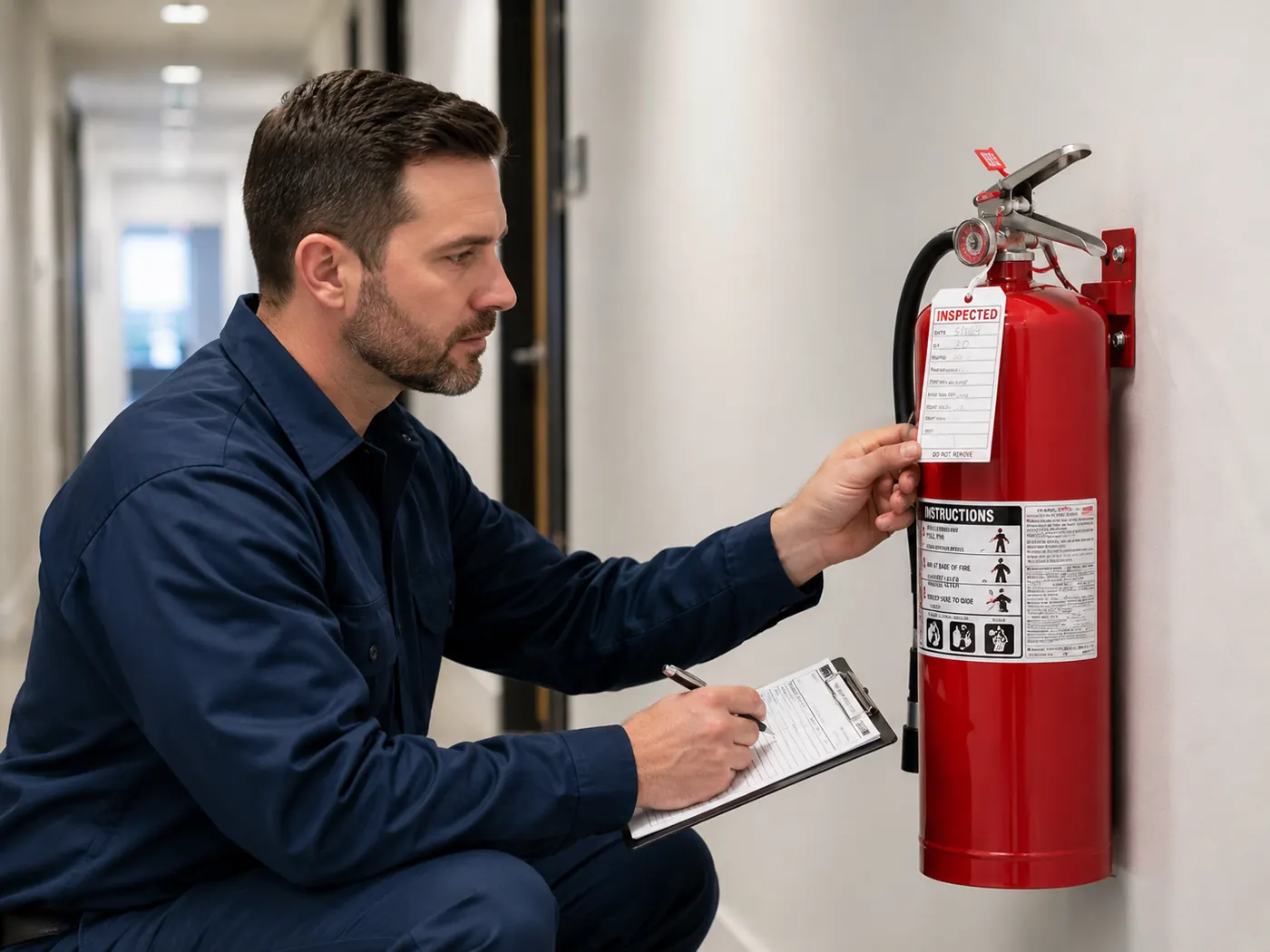
During an annual inspection, our technicians verify each extinguisher against a detailed checklist derived from NFPA 10 requirements. We check the gauge pressure to confirm the unit is fully charged. We examine the cylinder for dents, corrosion, and physical damage. We inspect the valve, handle, pin, and tamper seal for proper operation. We verify the hose and nozzle are unobstructed and undamaged. We confirm the extinguisher is mounted at the correct height, is visible and accessible, and has a current inspection tag. Every unit receives a new dated inspection tag upon completion, and any deficient units are flagged for immediate service, recharge, or replacement.
Hydrostatic Testing
Hydrostatic testing is the process of pressure-testing a fire extinguisher cylinder to verify its structural integrity. NFPA 10 requires hydrostatic testing at specific intervals depending on the extinguisher type: every five years for water and CO2 extinguishers, and every twelve years for dry chemical and clean agent units. During the test, the cylinder is filled with water and pressurized beyond its normal operating pressure. If the cylinder holds pressure without deformation or leakage, it passes and is returned to service with a new hydrostatic test date stamp. Cylinders that fail are condemned and replaced.
Delta Fire Equipment operates a fully equipped hydrostatic testing facility, allowing us to test and return extinguishers quickly without extended out-of-service periods. We also provide loaner extinguishers during testing to keep your property in compliance while your units are at our shop.
Recharging and Replacement
After any use, partial or full, a fire extinguisher must be recharged before it can be returned to service. Our technicians recharge extinguishers with the correct agent, at the correct pressure, to manufacturer specifications. We also provide new extinguisher sales and placement consulting, helping you select the right type, size, and quantity of extinguishers for your specific occupancy and hazard classification.
Get Your Extinguishers Inspected
Whether you need a single extinguisher replaced or a full facility inspection program, Delta Fire Equipment makes it simple. Call 1-800-983-8096 or request a quote online to schedule service anywhere in California.